Posted on Leave a comment

Diary of an Apprentice Astronaut

Penguin released the English translation of “Diary of an Apprentice Astronaut” by ESA Astronaut Samantha Cristoforetti last week (link here). The Diary is a very personal account of what happened to the Writer from the moment she was selected for one of the first stages of the recruitment for ESA Astronauts till she landed back in Kazakhstan after 200 days in Space on board of the International Space Station.

Please trust my opinion, this should be the next book you read, if you are even just remotely interested in aviation and space exploration.

Indeed, let me say that only a few books were able to capture my interest, satisfy my curiosity and then pierce my layer of critical filter to touch directly my core values and feelings.

Richard Bach wrote in a famous article: “Any [pilot] who would print his loves and fears and learnings on the pages of magazines says farewell to the secrets of his mind and gives them to the world.” This is what Samantha Cristoforetti did by opening her diary to us.

But let’s get to what I loved of the book:

All the information you wish for, never overly technical

Only a few people have the gift to explain complex things in easy terms. Thanks to this great ability of the Author, I managed to discover a lot of aspects and details of the background of a space mission without getting lost in difficult scientific explanations.

The language is direct and clear, the way you would indeed expect from a pilot and astronaut, but don’t think the book is at all a dry description of technical aspects.

To the contrary, you’ll see how relationship, teamwork and friendship are at the core of space exploration. Reading the book you realise how all space missions rely on a planetary network of agencies, scientists, expert, trainers, technicians that work around the clock and around the globe. Astronauts in training travel around the globe to the different agencies to train on modules, procedures, suits and tools over a period that lasts around 2 years.

If the extent of this global cooperation is somewhat new to you, you can’t avoid asking yourself, why don’t we cooperate so well with each other also in all other fields?

The descriptions

As said, the book is far from being some sterile technical account of events. A side that I truly enjoyed are the descriptions of places, people and rituals. I don’t think I will ever visit the Cosmodrome of Baikonur or Star City, the complex outside Moscow where astronauts train, but in my head I could almost tell you how the coffee and cookies taste and what precise tone the carpets are. I could imagine to walk in the room where they serve a royal-like buffet before the departure of the astronauts and I could imagine to smile and nod while hearing a toast in Russian. I could almost feel the pain in my forearm when the Author describes the difficulty of grabbing an object while wearing the rigid gloves of the EMU, the NASA suit for extravehicular activities.

Reflections on human life

This is not a book about philosophy nor about politics and a few ontological questions pop-up very discreetly only every now and then. However, who saw our planet from 400km of height acquires necessarily a different perspective on the life on our planet. The lifespan of the whole mankind is absolutely irrelevant compared to the age of Universe. Yet too much of our life gets wasted in fights and diatribes. If we became more aware of how insignificant our existence is compared to the rest of Universe, perhaps we would be more compassionate towards each other.

I loved this aspect of the book because it’s a feeling I also share. Let me be clear, I have little to share with the experience of the Author. I have very little experience of microgravity limited to a few instants in some aerobatic manoeuvre and I would probably never be able to spend more than a week with the same 6 individuals in the limited room of the International Space Station. Nevertheless, I understand somehow the feeling, as this is similar to what I and many other pilots feel after a flight where we managed to contemplate the beauty of nature: humbled and grateful.

In conclusion

I found it a very inspiring reading and I would strongly recommend it to anyone, but especially to young readers.

Diary of an Apprentice Astronaut is truly a great book and I am confident you will be as satisfied with the reading as I was. Now, when I look at the sky and spot the ISS at night, I feel a whole new sense of familiarity with that strange object and its inhabitants.

The book is available in English, Italian and German at any online bookstore (not sure, why the changed the cover in the English edition, I personally prefer the Italian version, below).

Also, all proceeds of the Author go to charitable organisations.

Do you want to spot the ISS at night or verify whether it was that light spot in the sky? check here: http://www.isstracker.com/

As usual, I am happy to hear your comments!

Benny

Posted on Leave a comment

What pilot watches to own in 2020


The Aeronaut has finally completed its list of most appreciated watches for 2020. This doesn’t mean that the watches have necessarily been released this year. It’s more a view on how they compare to peers and the general trends in terms of watches.

It was a really tough choice because of the many excellent watches available. Also, I hope you will forgive the delay in publishing this list, but due to very high workload it was impossible to write earlier.

Enjoy and be safe!

Gavox Spitfire

This image has an empty alt attribute; its file name is Spitfire.jpg

Gavox is one of the brands I love for many reasons: Michael Happé designed this watch for pilots and maintains its impeccable taste throughout all models while ensuring to meet the operational needs of any aviator: readability, durability and precision. Do you need a proof for this? Many fighter jet pilots and also cinema celebrities like Monica Bellucci wear Gavox on their wrists.

Let’s get, however, to the reason why I chose the Spitfire. Right when I felt satisfied about my collection of pilot watches by Gavox and was thinking to move to another micro brand, Gavox released the Spitfire and it was love at first sight! The Spitfire features a 36mm case, sapphire crystal and a Seiko quartz movement. You read right: 36mm! In facts, in today’s world, this is an unusually small size. However, I tested the watch in flight and can enthusiastically say that this is a pure pilot watch, well readable even during bumpy rides. But its charm is not limited to the sky. indeed, it will catch a lot of attention also discretely sliding out of a suit’s cuff.

The price is EUR 210 at Gavox shop.

Bulova A15

This image has an empty alt attribute; its file name is bulova-a15.png

Bulova is a name that grew closely linked to the American air and space industry. The NASA chose their clocks to display the official time in the control rooms of the US space program during its Mercury, Gemini and Apollo years. Bulova’s Accutron even made it to space during Apollo 15.

The recently issued A15 is the remake of a watch commissioned by the US government for the military pilots in 1943. The government requested a reliable and solid watch and it needed to have a very specific function: keeping track of the lapsed flight time. Only a few test watches were produced, the series production sadly never took off. Along this line, many things changed over time: Bulova went into financial trouble is now owned by Citizen and this watch mounts a Miyota automatic movement instead of one of the innovative and original movement Bulova became known for. Nevertheless, we have to be thankful to Citizen for keeping alive a brand that accompanied some of the bravest conquest in mankind.

However, I chose this watch for three main reasons: 1. the way its 42 mm case looks and feels is absolutely amazing, 2. I keep cheering for Bulova and hope in the future it will make us talk because of some new crazy proprietary movement and 3. I desperately needed a watch with a lapsed time marker for my flights.

The hands and dial numbers are treated with blue luminescent paint.

The watch prices around EUR 499 and is available from multiple online stores.

Breitling Navitimer B01 Cronograph

This image has an empty alt attribute; its file name is breitling.png

One may argue that recommending to purchase a watch that has been around for ages does not make much sense. I disagree and I will tell you why: Breitling recently became property of a private equity fund. Accordingly, the group took some decisions that are in my view excessively profit oriented and disregard the long tradition and history of Breitling. under the new owenrship of CVC Capital partners, the company is selling a new version of “Navitimer”. Unfortunately the new watch has very little to share with the original model holding this name: the Navi-8, the name given to the new Navitimer, indeed has no flight ruler, no cronograph and no proprietary movement. So my choice to include the B01 is a way to celebrate the real Breitling spirit with one of the most iconic models ever made.

Unimatic – Modello 1 (U1-FN)

This is not exactly an aviator watch. It’s a diver’s watch, which works great also in the air. Indeed, it offers a very simple dial, with minimum visual disturbances. The hands are treated with Super Luminova (R) C1 and the case is dark and brushed, which prevents disturbing glare when flying on a sunny day. All these features together ensure maximum visibility. The caliber is an automatic Seiko and the watch is water resistant up to 300m.

Price is currently EUR 625 on the Unimatic website.

Posted on

A very special passenger

A few times I have offered her old to join me for a flight. She generally declined in various ways, ranging from a diplomatic “oh today is not a good day, what about tomorrow?” to a more direct “No, I don’t want to!”

Still flying with her remained a big dream for me.

A few weeks ago, a friend with whom I was supposed to fly called me in the morning to say he could not join.

“Well” I thought “perhaps this is the time”. So without inquiring or explaining too much, I told my daughter and my wife that I needed to go to the airport and whether they wanted to come with me. Once there, I asked the little one whether she would like to fly with Dad and see our house from the sky. Her excited smile mattered the world to me. I walked her to the DA40, which was waiting for us out of the hangar, did the walk around with her, answering to any question she might have and then sat her in the plane.

She loved talking through the headset. It was so funny to see how she tried to act and talk through the mic as professional as a six year-old can. The day was relatively calm, but we felt a couple of bumps here and there. I explained to her this was normal and she wasn’t scared at all. She loved to watch the town and the fields from a 1000 ft. Eventually we flew over our home. When she recognised it, she could not contain her excitement. “Papa, that is our home! Look!”

We headed back and, after landing, completing the final checklist and removing the headset, she looked at me and told me the words that every pilot and father would like to hear: “Papa it was the most beautiful thing I have ever done! I want to come with you every time you fly!”…. she waited a few more instants and then again: “Papa, can I give you a kiss?”

I wanted to share with you this very emotional moment for me. Did you fly with your kids? How was it? Feel free to drop me a line!

Posted on Leave a comment

5 things to do during the Covid-19 pandemic

Coronavirus is causing huge disruptions across the globe.

The main danger coming from this virus is that it doesn’t necessarily present symptoms in a number of infected individuals while it can have potentially deadly consequences on others. The only way to fight this for the time being, i.e. as long as a vaccine is not available, is to stay at home as much as possible and avoid physical contacts apart from the people with whom we live.

As a pilot it is particularly frustrating to have to stay at home, especially while the weather in the northern hemisphere is getting better and better. So here’s a short list of 5 things you can do to face the lock-down in the most productive way for yourself and your family:

#1 Keep your boat clean and take care of yourself

Most of us are forced to stay at home, but this is not a good reason to spend your day in pajama and slip into laziness mode. To the contrary, make sure you shower, shave (if you happen to have facial hair…), dress up and keep your home a comfortable place for you and your family. This will help you enter into a better mindset, but will also signal to the rest of your family that you have everything under control.

#2 Have a daily routine

Follow a daily schedule and make sure your kids have one too. This helps making the most of this time as you will be able to syncronise your working time with their studying and then have place for fun together.

#3 Remember the 8-8-8 rule

There are 24 hours in a day. The change of habits can challenge the way we organise our day. Make sure you dedicate 8 hours a day for work or other intellectual activity, 8 hours for relaxation or fun and 8 hours for sleep. This will help you avoid accrual of unnecessary stress.

#4 Use the time to refresh theory and use flight sim to test your readiness to act in difficult situations

Time on the ground can be still used for a lot of aeronautical activities. Go back to those parts of your training which you like the least (mine is airlaw, I have to admit) and refresh them. Also if you have a flight sim on your laptop (and I am positive most of you do), simulate difficult situations like gusty winds or system failures.

#5 Read some good aviation book

Here are my favourites:

  1. A Gift of Wings – Richard Bach
  2. Flying the Knife Edge: New Guinea Bush Pilot – Matt McLaughlin
  3. Better Aerobatics – Alan Cassidy

Stay safe!

Posted on

A night flight

I love Cyprus. Its light and its scent are unique. When you get out of the international terminal of Larnaca, you feel a special warmth in the sun and in its blinding yet joyful light. A similar feeling I derive by my frequent exchanges with all the Cypriot friends I had the fortune to meet in the past two years. Indeed, I pass by here frequently and anytime I am impatient to log some flight time and feed to my brain some unique memories of the breath-taking landscape of the Island.

20191215_135606
Limassol and the peninsula of Akrotiri

Although when you fly in Cyprus you feel relatively constrained by the VFR routes, the limited availability of G-airspace areas (a type of uncontrolled airspace) and a number of restricted areas along the path, it’s an experience that I strongly recommend to any pilot for a good series of reasons:
• The landscape is absolutely amazing in any season and in any moment of the day.
• You can find not only very skilled FIs, but also great people with whom to share the passion of flying.
• You can start from Cyprus to do some island-hopping.
• The cost is generally more reasonable than in other countries and possibly set to decrease for fiscal reasons.


I have been in contact with Demos Ektoros for quite some time and I have regarded him as one of the friendliest and most helpful instructors I know since our very first contacts. He opened a flying school called The Pigeon (link to their Facebook page here) and together with a passionate investor they are building the youngest fleet on the Island, with a few brand new Tecnams. So, if you are interested in discovering this part of Mediterranean by plane or simply wish to do some hour building, give him a call and enjoy a service of the highest level!
I was excited to try the P2008. It is a high wing plane with a nice slick line. The cabin is larger than its predecessor the P92 and is mostly made of composite materials, while the wings have a metal infrastructure. The combination of the engine (a most common Rotax 912s) and the very capable tanks (with a stunning 110-litre capacity) makes the plane able to undertake long navigation.

The glass cockpit solution by Garmin complements the ability to travel long distances with remarkable peace of mind along the trip.
When we fired the engine the weather was just ideal: a few clouds crowded the west of the Island, but above our heads the sky was of a deep blue, the wind was around 12 kts perfectly aligned with RWY 04 and the temperature was a mild 14 degrees Celsius.
The P2008 is a remarkable machine: the interiors are incredibly well designed. The dashboard is well designed and you find all switches easily thanks to their size and the backlit indications.
One major improvement from the P92 and the P2002 is the flap lever, which doesn’t need to be kept in position till the flaps reach the desired angle. This means having your right hand busy only for an instant in a busy phase of flight, unlike in the older models. The steering on ground is by differential braking (also very welcome change).
So let’s get to the fun part, i.e. the flight. We line up behind an Airbus from Aeroflot and take off from RWY 04, the two-seater climbs beautifully passing in front of Mackenzie Beach (a very sweet spot in Summer). The VFR procedure of Larnaca requires you to fly over the Salt Lake which is north of the airfield and from there enter the chosen VFR route.
In Summer the lake is often dry, but in winter the orange evening sun reflects on its waters making the view simply incomparable. We continue towards the training area of Makri, north of the mountains. The Garmin is a stunning navigational aid as it projects the flight plan over a 3D profile and it is so well programmed that you may almost forget to look outside and enjoy the view.
I flew over a couple of dams, which are vital for the Country, and enjoyed the long dark shadows plotted on the ground by the dying sun. From Alampra we headed directly to the Salt Lake and I had the impression that darkness falled upon us almost abruptly before reaching the lake.
Doing traffic patterns in an international airport is beautiful and in Larnaca the ATC is also particularly friendly. Under Demos’instructions, I performed a few traffic patterns and a forced landing in the dark. The plane handles perfectly, the lighting system is very good and makes night landings as easy as daylight ones.
Taxiing back to the apron, you wish you could just fly that plane to the last drop of fuel available.
But, now it’s time to let the picture speak for themselves. Once again many thanks are owed to Demos for his time and dedication. If you pass by Cyprus and like to fly, The Pigeon Aviation School is by far the best solution, if you care for a friendly environment and brand new planes!

Posted on

Learning Aerobatics

“Perhaps, this is something I will regret…” I can’t even finish the thought when the abrupt change of direction of the Robin 2160 draws all my brain power to try understand what is going on around me.

Udo Pieh, the instructor and owner of MKM Flight Training in Mainz (Germany), is showing me the minimum amount of acceleration (Gs) he wants to feel when I am in control of the plane.

He asks me to perform a steep turn with 60 degrees. I do my best, considering that it’s not a manoeuvre I practice daily. Udo taps with a finger on the accelerometer: “1.5 G… not enough! – exclaims smiling – How many shall I see?”

“Two” I answer, almost instinctively.

“Then show me 2 Gs” he adds laughing … and there starts my course for the aerobatic rating!

Let’s start from the very beginning: a few weeks before I booked a trial lesson with MKM Flight Training. The reason why I booked it was very simple: I want to progress on the path to become a safer pilot, learn something new and perhaps test my body’s tolerance to Gs.

For some reason, aerobatic flying is one of the aviation disciplines that attracts most attention from non-pilots for its spectacularity, but very often it is avoided by airmen.

The image of a plane flying in all directions and fashions, except levelled and straight, best than any other represents the idea of freedom.

However, I share what Alan Cassidy, an icon of aerobatics, wrote in his must-read manual “Better Aerobatics”. He explains that the representation of aerobatics as something free of rules is very misleading and that the one quality an aerobatic pilot can never lack is extreme self-discipline.

I believe thrill-seekers are not good in aviation, regardless of what and how they fly it. I think aerobatics is no exception. As Udo said during our first lesson, quoting a known aviation say: “there are bold pilots and old pilots, but not old bold pilots”.

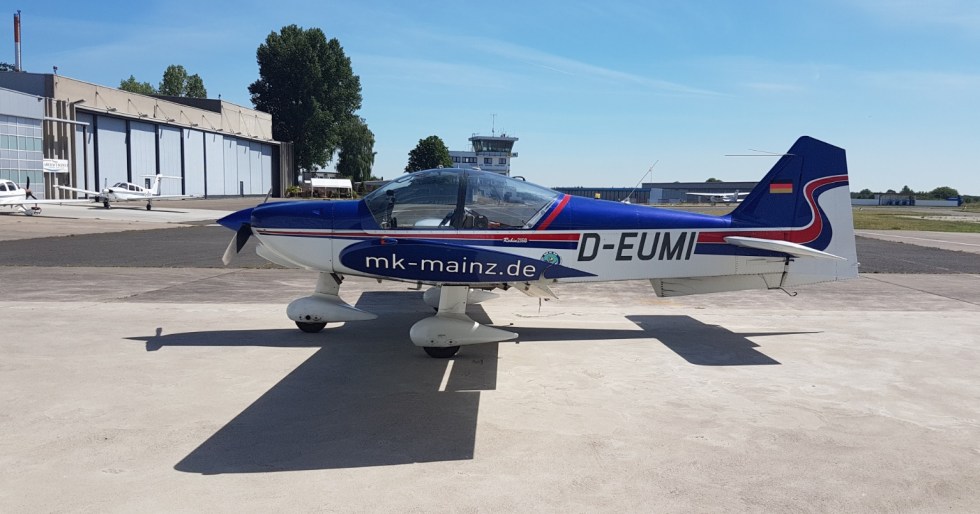
So, I showed up at Mainz airfield (ICAO: EDFZ) at 8.30 of a sunny summer morning. At the hangar Udo welcomed me and introduced me to the plane: a shining Robin 2160 powered by a Lycoming 0-320.

D-EUMI

I notice the long ventral fin running all the way to the tail. I liked instantaneously the profile of the plane and the front-sliding canopy.

Udo runs the pre-flight inspection with me, makes reference to a couple of peculiarities of the plane and then he hands me the keys to take the plane to the fuel station.

After the refuelling, we wear the parachutes. Udo explains me how to jump out if need be and in matter of minutes we’re running for take-off.

The parachute briefing doesn’t really help me gather courage, but in matter of 2 minutes we are already running on Runway 08 for take-off.

The day is ideal, with a clear sunny sky, but still no thermals.

We start with steep turns and as soon as I make a clean 2G 60 degree bank turn, Udo informs me that that’s the only way I am allowed to turn from that moment on.

He then guides me to perform an entry into a spin.

Some friends spoke of it as one of the worst feelings a pilot can go through. I don’t share their view: spins develop quickly, but the plane (and most planes in the SEP category are like this) will recover as soon as pressure is released from the control stick and the rudder is in neutral position.

After the initial figures, I feel much more relaxed. I don’t feel sick and my curiosity is only increasing.

We do a few more and I get more and more and more comfortable with the quick rotation of the aircraft and the loss of altitude.

From there on, I am hooked and hungry for more figures. Udo guides me through loops, split Ss and Immelmanns.

An important aspect of most aerobatic manoeuvres regards vestibular illusions. Closing a loop or recovering from a spin impress on the body a lot of G force. When still not familiar with the aircraft and without having developed an eye for the attitude of the plane without looking at the attitude indicator, a pilot may have the illusion of being climbing while they are, as descending quite quickly as a matter of fact.

After the first lesson, my head is busy processing all the information and rethinking about the timing of each move.

In the following lessons I practice rolls, snap rolls and hammerhead (or stall turns). The more I fly aerobatics and the more I wonder whether I will ever be able to fly straight and levelled again!

Another lesson I learnt, is to make a pre-flight check of myself. Learning aerobatics requires being responsive and “consequential” as Udo says. If you didn’t sleep well and feel you are sleep or distracted, it’s better not to waste time, money and, worst, risk “being flown” by the aircraft instead of controlling it.

If you start this course, and I truly recommend it, bring an action camera (or better two) with you. It provides a very good learning support in between lessons from which you can learn a lot.

Find some of my footage below, both in 2D and 360 VR format.

I look forward to receive your comments!

Blue skies.

Posted on

An aborted flight, ADM and hazardous attitudes

The sequence of events is pretty simple: I showed up at my base airfield, walked to the plane and ran the pre-flight inspection. Everything looked good as always. My guests and I took our seats and I started the engine. The sky was clear and the wind was slightly gusty, but perfectly aligned to the runway.

During the engine run-up check, there was no indication of any malfunction, so I lined up and applied full power checking all items: “Airspeed alive, all engine instruments ‘green’, power 100%”.

After rotation, I felt a vibration for a couple of seconds. It was strong enough to draw my attention and trigger my brain to start comparing it with the memory of previous take-offs. However, it quickly disappeared, so I continued the climb, ascribing it to the gusty situation and possibly some adjustment of the propeller pitch (the plane I was controlling has a hydraulic pitch control system that works autonomously to yield the optimum power output for each situation). Another 10 seconds in the climb, the vibration showed up again. I had the clear impression it came from the engine bay. Speed, climb and engine were still in the green.

A number of questions crowded my head, such as “What to do?”, “Is it just me being overcautious?”, “How would my instructor react?”, but none of these could guide me to a proper solution of my problem, so I forced my head into a more orderly and neutral assessment: is it unusual? YES; is it affecting a vital system of the plane? YES; What is the nearest airport? Clearly the one I just left. So, I announced I was coming back. The voice on the tower acknowledged. During the other segments of the traffic circuit, the engine -now with lower power settings- continued to vibrate at intervals. The landing went fine and was possibly one of the softest I have had this year.

I taxied back and asked to have the plane checked. After 15 minutes, the technicians had downloaded the computer data, but they seemed inconclusive and more checks needed to be carried out.

So, I left the airfield with a bitter feeling. A lot of thoughts went through my head as I drove back to the city, but all basically coming down to: “Was it me or the plane that ruined my day?”. I feared that perhaps I had been overly zealous after all and maybe my reaction was the result of a loss of self-confidence. On the other hand, the possibility that the plane had indeed problems, despite all pre-flight checks going well was also leaving me a bit shaken, as I have a lot of trust in that beautiful and complex machine.

I watched the video I took with the GoPro (which is posted below) and I chewed on my thoughts during the night. I woke up reinforced in the opinion that I had done the right thing: I have one life and I have one propeller, nothing justifies taking a risk.

Walking down to my morning coffee, I read a message on my phone saying they had indeed found problems with one of the components of the engine. If the flight had continued it may have later developed into a catastrophic failure.

I was happy to know that I made the right call. At the same time, I though of what made me almost go ahead with the planned flight. I found it was very likely the attitude of some macho-type instructor during my training, too quick in discarding my questions and ignoring problems as they arose, and then the attitude of some pilots around the airfield. For this reason the initial question “what would my instructor do?” was the wrong one to ask.

It’s a great lesson learnt for me in the field of Human Factor, one which I am happy to share with you. As usual, feel free to send me your comments: have you ever been in a similar situation?

If you want to learn more about hazardous attitudes for pilots check the FAA’s materials on aeronautical decision-making here.


Posted on

Learning to fly seaplanes in Como

Aviation is a very broad world and I am fascinated by every side of it. Among these, I have been truly curious about seaplanes for a good while.

I love to watch videos of Alaskan or Canadian seaplane pilots. The image I have in my head is that of glassy lake water rippled by the waves impressed by a plane on take off. The freedom that seaplanes bring to the people living where the planet is more impervious is also a charming side of it.

And then, one of my aviation buddies did his ‘SEP-SEA’ class rating in Como, in northern Italy, and told me all about his experience and the ‘seaplane fever’ quickly took over.

I browsed a bit to see what alternatives exist in Europe, but in no time I decided to go for the class rating in Como.

The reasons are very simple: The school is the oldest sea plane school in the world still operating, the price was reasonable, their fleet offers a good range of choice (including some old timers) and you have the opportunity to learn to fly sea planes in one of the most amazing places in the world, where famous international movies were shot and were George Clooney lives. While I know for you it won’t probably matter, I also had the reference of my good friend Onur, who is somebody I would trust blindly when it comes to flying.

I sent an email to the Aeroclub Como, they replied in matter of minutes with a list of possible dates and timetable. By end of day, it was decided, I was going to fly in Como.

***

The walk from the train station to the hangar of the club takes around 5 minutes,  passing in front of some charming hotels from the beginning of 1900 and the beautiful seat of the Yacht Club Como in its rationalist style. For my first day of training, the sun was bright and there were no clouds to be seen.

When you enter the hangar of the Aeroclub, you can only remain silent for a moment: a couple of Cessnas on floats are generally in the front row and when you look behind them you can’t miss a 1946 Seabee, a PA-18 amphibian, a Cessna ‘Bird Dog’ (305C) and then one of the most beautiful sea planes (and the oldest in its original configuration) still flying today, the 1935 Caproni Ca 100, restored by Gerolamo Gavazzi.

I was greeted by Paolo, my instructor, and we started the briefing. He explained the basic differences between land- and seaplanes, what circumstances are dangerous and how to assess the surface conditions. Then we headed to the pier where I-PVLC, a C172, was waiting for us. The pre-flight inspection is a bit different from the one I am used to: I had to learn a couple of sailing knots, spend some time to ‘read’ wind and water and consider the waves when measuring the fuel with the dip-stick. Oh… and of course, not to fall in the water when the waves lifted by some large boat reach the plane.

It is normal to find water in the floats: when landing on water, the floats are subject  to hard contact with the water surface. In order to resist, the floats need to have some degree of elasticity, which, on the other hand, allows water to penetrate. So a key part of the pre-flight is to empty residual water from the floats.

IMG_20190322_173714_324

We finally sat in Lima-Charlie. Half-way through the checklist I finally fired the engine and took a moment to enjoy the sound of the Lycoming O-320. I love the scale of sounds it produces compared to a relatively high-pitch Rotax.

Once the engine is running the sea plane is constantly in motion as there are no breaks. To steer it, small water rudders at the end of each floater are lowered and are controlled with the pedals. No matter what, when on the water the pilot must generally apply some back pressure to the elevator in order to prevent the propeller from hitting the water or to avoid flipping when taxiing at high speed.

20190322_143033

After warming up the engine, we eventually lined up for runway 01 (AD chart available here), ran through the last checks and applied full power to the Lycoming. The take off from water requires much more energy than form paved surfaces. When the plane accrues speed, it initially pitches up because of the pressure applied on the elevator and soon touches the water only with the small surface around the step at the end of the keel. At that moment it is fundamental to adopt an attitude that reduces the drag with the water as much as possible. Once adopted the right pitch angle, this must be kept till the plane lifts off. There is no rotation when taking off from water: if the tails of the floats sink back into the water they will slow down the plane and retard or make impossible to become airborne.

Lima-Charlie accelerated smoothly over the waters of the lake and after not long the noise and the vibration of the high-speed run on the water disappeared and the plane was in the air.

The floats change quite radically the distribution of weight in the plane. Compared to a normal C172 rolling seems to be much easier. However, a lot more action is required on the rudder pedals to counter the inverse yaw.

After adapting myself to these aspects, I could enjoy a bit of the breath-taking view. IMG-20190322-WA0021

Under Paolo’s instructions I prepared for the first sea landing. The first thing to assess, particularly in some narrow parts of the lake, is the wind direction. Waves, Sailboats and smoke are particularly helpful for this purpose. Then a pilot must assess the conditions of the water. Landings over glassy surfaces are very complicated because the pilot is not able to assess precisely the distance from the water. Touching the water with a nose-down attitude may have catastrophic consequences. Another risk is that of stalling while the plane is still considerably high above the surface.

In the following 8 hours (divided in 7 flights and with 3 very experienced FIs), I got to practice different techniques for take off and landing, I managed to land on a river and had fun water-taxiing at high speed to learn how the plane behaves on the water.

Adopting the right pitch angle for each phase of flight is possibly the single most important piece of advice. At one point during the training, the instructor covered with a post-it note the airspeed indicator, altimeter, VSI, RPMs indicator and made me repeat all different types of landings. I loved to fly the Cessna relying on the seat-of-the-pants. On one hand, it made me pay more attention to the machine rather than the indication and by doing so establishing a much stronger connection with the plane. On the other, the Cessna revealed itself as a pilot-friendly bird that can communicate with the pilot very effectively through the noise of the engine, the intensity of the stall warning (most sea landings happen with the stall warning horn blowing loudly) and the change in pressure perceived on the yokes when it enters into ground-effect, instants before touch-down.

After the 8 hours of training, I felt comfortable with the machine and all techniques part of the test. Needless to say, that there are many other manoeuvres that I need and want to learn during my next trips to Como.

If any of you is even remotely interested in trying a seaplane, then I can only recommend that you do so as soon as possible! I loved every minute and every mile of it, regardless whether in the air or on the water… and now seaplanes are the main component of my aviation dreams!

In addition, I had a truly great experience in Como: I found the level of the instruction genuinely high and came back with notions I can use in my normal flights with a land plane. On top of that, flying at Aeroclub Como truly brings together the beauty of this segment of aviation with the charm and the traditions of one of the finest regions in Italy.

If you have any question, feel free to send me a message. I am happy to share more about my experience.

Should you be more curious, you can find a lot at the FAA website, which made available a lot of cool materials here

As usual, no part of this post should be interpreted as an instruction, an advice or a solicitation of any type.

Cheers!


Posted on

Flying the knife edge

I have to apologise to all of you for such a long break. Unfortunately, this is the collateral effect of excessive work and study. The good news is that finally I found time to publish my review of a fantastic book. This volume, without any question, is now one of my favourite books about aviation and a must-read: “Flying the knife edge” by Matthew McLaughlin.

I cannot recommend enough this book to anyone interested in aviation, regardless whether they have a pilot license or have absolutely no clue about what bush-flying is. “Flying the knife edge” is one of the most comprehensive, entertaining and informative books on aviation.

It is basically about Matt’s experience as bush pilot in one of the most dangerous areas of the globe for a pilot, Papua New Guinea. However, there is so much more to this book: the story about the author’s struggle and challenges to become an airline pilot is accompanied by brief historical and technical insights and also some very funny accounts.

Flying in Papua, before turbo-prop planes became common, meant flying with very thin safety margins between short unpaved and unforgiving landing strips, “on the knife edge” one would indeed say. The descriptions of certain flights flight or approaches will take your breath away and ‘glue’ you to the pages until you know the not-always-positive ending.

Just to give you a flavour, imagine a place with little or no radio navigation aid at all, a deadly territory where entering the wrong valley means having no way out and on some landing strip there’s no go-around as a vertical rocky wall stand in front of you at the end of the runway.

As I said, I loved this book. I loved it because it’s a well-balanced mix of all those elements that I enjoy in aviation: personal reflections about the life and risks of a (bush) pilot, history, technics, beautiful planes and friendship. Also it is always explained in simple terms so that really anyone can read it and enjoy it.

In many parts of the book I thought about the internal dilemma of how much risk is worth taking in order to pursue one’s dream. Depending on your “risk appetite” and most likely what phase of your life you are currently going through you will answer differently.

Also, one may wonder how a new MPL airline recruit would stand compared to an old-school pilot.

Please read it and let me know if you share my opinion.

Posted on

A flight in Cyprus

One of the reasons why I value my job, is the opportunity to visit regularly different countries around Europe. What I normally do is to find an airport and rent a plane to fly around.

Two things made me dream of my latest trip: the country, Cyprus, and the plane. Indeed, I finally managed to fly on a Tecnam.

I landed in Larnaca (ICAO code: LCLK) at 14.45 and at 15.30 I was already running the pre-flight inspection of 5B-CLE, a Tecnam P92JS owned by Nemax Pilot Training.

Nemax is a small school, but they offer all pilot courses and offer a fleet of planes at a very reasonable price. I liked the friendly, relaxed yet deeply professional atmosphere and I am  looking forward to my next trip to the Island to do some hour building and seriously considering some additional steps in my training with them.


The P92 is a high-wing plane, with a nice aerodynamic profile and characterised by a very light weight (its first version was indeed conceived for the ultralight market). It uses a stick control, like in the Katana, but the nose wheel is directly connected to the pedals and the breaks are controlled by a lever between pilot and passenger seat, which makes taxiing a little different from what I am used to. I could write for a few pages about Tecnam, but I don’t want to repeat myself, so take a look at my previous article about Tecnam’s founders, the Pascale bothers.

The airspace of Cyprus is not particularly vast, but due to the presence of military installations and high terrain, VFR flights must be conducted according to pre-defined routes between Paphos and Larnaca or to training areas in airspace G. Flight plans must be submitted for all flights departing Larnaca. The VFR chart is available at the website of the Department of Civil Aviation of Cyprus (link here)

Capture

Zakos, joins me to guide me in the familiarisation with the area. We contact the tower to request the start-up and receive the expected taxi instructions via CU and B. Large airlines like Lufthansa lands in Larnaca. We waited around 20 minutes in front of holding point B enjoying the close touch down of a few A320s and then were cleared for take off by radio and by the green lights on the taxiway.


I lined-up the P92 and applied full power. I barely had the time to call the speed because the P92 likes short take-offs and it accelerated and detached in matter of instants. We overflew the right (north) downwind of runway 22 till over the Salt Lake and then entered the VFR route for the Marki training area.

I like the P92JS, the checklist is short and you can focus on flying. Due to its lightweight and high-wing configuration the pilot must fly in the most precise manner to avoid the cabin to swing sideways. I like this aspect of the machine because it helps me focus on my primary goal as pilot, i.e. flying well!

I tried the usual check ride manoeuvres like steep turns and stalls and I still have a baby smile on my face. Having tried the Savage Cub, I was expecting a wing drop while attempting the stall much earlier, but it just didn’t drop.

Fully satisfied by the behaviour of this plane, I enjoyed the landscape in front of my eyes: green fields, hills hiding small towns and then river becoming lakes just before a dam.

IMG_20180205_174211_915

The weather was so enjoyable at 22 Celsius, even inside the cockpit, where typically every temperature above 20 is easily doubled. We then left Marki, via the reporting point of Alampra and then went back to Larnaca for some Traffic patterns.

Cyprus big

The standard traffic patterns develops to the South of the airport of Larnaca, which means that you fly over the sea. I loved this too: a light blue sea, completely transparent and reflecting the glare of the sunset depending on the angle.

This plane flows beautifully through the air and has a great glide ratio. Something to keep in mind on a short final, where excess energy is hard to dissipate.

Indeed, the P92 loves to fly and you really have to convince her to get back on the ground.

…Oh wait, perhaps that was me!